

Don’t take it personally. Take it professionally.
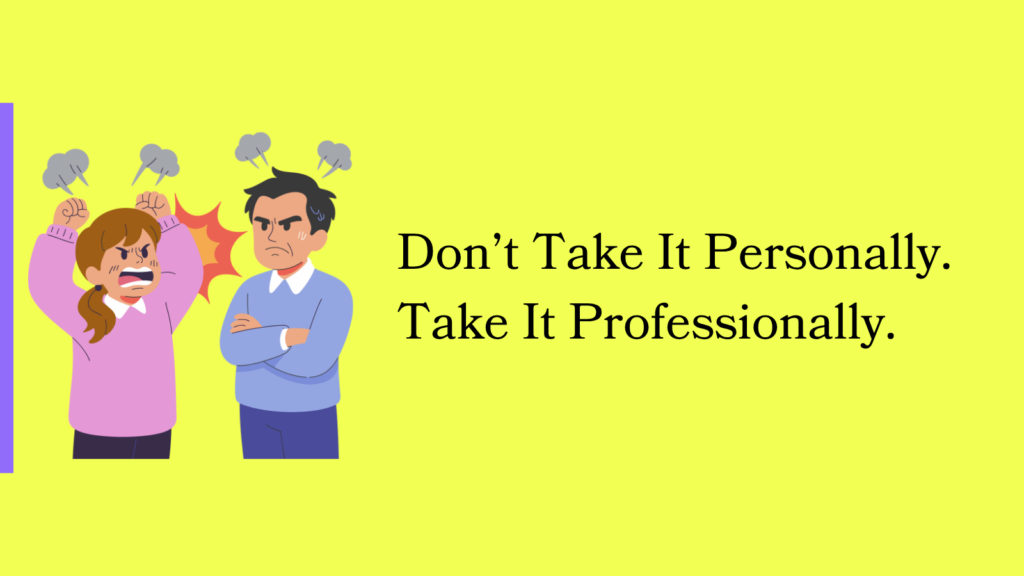
Every workplace, no matter how healthy the culture or how mature the team, will at some point boil over. A deadline missed, a dismissive comment in a meeting, a piece of feedback that lands harder than intended. In those moments, the instinct is to react to defend yourself, to feel wounded, to withdraw or push back.
But that instinct, however human, is rarely useful. The professionals who consistently rise, who get trusted with harder problems, bigger teams, and greater responsibility have learned a different reflex: the ability to de-personalise pressure and redirect it into forward motion.
This isn’t about being emotionally cold or pretending problems don’t exist. It’s about developing a kind of professional composure. A practiced separation between what happens to you and how you choose to respond to it.
Here’s a detailed guide on how to do exactly that, with real-world examples and frameworks you can apply starting today.
“Between stimulus and response, there is a space. In that space is our power to choose our response. In our response lies our growth and our freedom.” — Viktor Frankl
Why Emotions Run High at Work
Before we talk about managing professional emotions, it helps to understand why they surge in the first place. Work involves several conditions that are uniquely combustible: high stakes, scarce time, public visibility, ego investment, and frequent ambiguity about roles and expectations.
You’ve spent weeks on a report and your manager redlines half of it. You raised an idea in a meeting and someone interrupted you to take the credit. A client responded to your best work with a one-line dismissal. These moments hurt, not because you’re weak, but because you’re invested. Investment is good. Unmanaged reactivity is not.
Add to this the fact that most workplaces mix different communication styles, stress thresholds, cultural backgrounds, and personal histories and conflict becomes not a sign of dysfunction but a near-mathematical inevitability. The goal isn’t to eliminate friction. It’s to move through it without losing your professional bearing.
The Core Shift: Separating Event from Identity
The root of most workplace emotional spirals is a simple cognitive error: confusing criticism of your work with criticism of your worth. When your proposal gets rejected, it feels like you are being rejected. When your idea is challenged, it feels like your intelligence is being questioned. These are understandable feelings but they are not accurate readings of reality.
Your work is something you produce. Your identity is something far deeper and more permanent. Keeping those two things separate is the foundational skill of professional maturity.
Real-World Example
Scenario — Design Review
A UX designer presents her wireframes to the product team. The lead developer immediately says: “This layout doesn’t work. We can’t build this in the timeline we have.”
Reactive response: She feels embarrassed and defensive. She either snaps back or goes quiet for the rest of the meeting.
Professional response: She pauses, nods, and says: “Understood, can you tell me which specific elements create the build complexity? I want to find a version that works for both UX and engineering.” The conversation moves forward. By the end of the meeting, they have a workable solution.
The developer’s comment wasn’t about her. It was about the timeline. She just needed to hear it that way.
The trick is to train yourself to ask a simple question whenever a comment stings: Is this about me, or is this about the work? In the vast majority of cases, it’s about the work. And work can be changed.
Removing Emotion Doesn’t Mean Removing Yourself
There’s an important distinction that often gets lost: staying emotionally regulated is not the same as being robotic, disengaged, or a pushover. You can be warm, passionate, and deeply invested in your work and still handle pressure without unraveling.
Think of it like a skilled surgeon. They care intensely about the outcome, but they don’t let that care turn into trembling hands or clouded judgment mid-operation. The stakes sharpen their focus, not their anxiety.
Key distinction: Removing emotional reactivity means slowing down your response, not suppressing your feelings. You still feel the frustration you just decide not to act from it until you’ve had a moment to think clearly.
Professionals who master this often describe it as developing a kind of internal weather system. Storms come and go, but the ground stays solid. They learn to observe their emotional state with some detachment — “I notice I’m irritated right now” — rather than being fully swept up in it.
Feeding Off Good Energy: The Underrated Workplace Skill
Most professional development content focuses on managing difficult situations. But there’s an equally important skill that gets less attention: actively drawing energy from positive environments, people, and moments.
Every workplace has pockets of good energy, colleagues who are enthusiastic and solutions-focused, moments of genuine team alignment, small wins that signal progress. High performers don’t passively wait for good energy to find them. They deliberately seek it out and let it fuel them.
Identify your energy sources. Who in your workplace tends to leave you feeling clearer and more capable after a conversation? Spend more deliberate time with those people not to network, but to genuinely engage.
Celebrate small wins explicitly. When a task lands well, a client responds positively, or a team milestone is hit, mark it. Don’t immediately move to the next item. Let the good register. This builds the emotional reserves that carry you through harder moments.
Protect your morning inputs. The first thirty minutes of your workday set your psychological tone. Many professionals find that starting with one task they can complete,however small creates a sense of agency that lasts for hours.
Real-World Example
Scenario — Team Energy Management
A project manager is handling two teams simultaneously. One is collaborative and proactive. The other is reactive and siloed.
He schedules his most cognitively demanding work, risk reviews, client strategy calls on mornings where he’s had a check-in with the collaborative team first. He uses their energy as a launchpad. With the reactive team, he’s more deliberate about agenda structure, knowing he needs to carry more of the positive framing himself.
He’s not ignoring the difficult team’s problems. He’s managing his own energy intelligently so he can show up effectively for both.
The Art of Receiving Criticism
Criticism is one of the most valuable things a workplace can offer you and one of the hardest to receive well. Most people experience it on a spectrum from mild discomfort to genuine distress, and the reaction is almost always instinctive: deny, deflect, or disengage.
But criticism even badly delivered criticism contains information. And information is exactly what you need to grow. The professionals who improve fastest are often not the most talented; they’re the ones most willing to hear where they’re falling short and do something about it.
The SPACE Framework — How to Process Criticism in Real Time
- Stop before responding. Take a breath. Even two seconds creates enough distance to prevent a reactive reply. Your nervous system needs a moment to downshift from threat-mode.
- Paraphrase to confirm understanding. Say: “So if I understand correctly, the issue is X, is that right?” This shows you’re listening and gives them a chance to clarify a blunt delivery.
- Ask for specifics. Vague criticism is harder to act on. “What specifically didn’t work for you?” turns emotional feedback into operational data.
- Check your interpretation later. After the meeting, revisit the criticism privately. Does it hold up? Is there truth in it, even if the delivery was poor? This is where real growth happens.
- Execute a visible change. If the criticism was valid, make an adjustment and let the person know. This closes the loop and builds trust rapidly.
Real-World Example
Scenario — Content Team
A content strategist submits an article to her editor, who responds: “This isn’t the voice we’re going for. It reads like an academic paper. Our audience isn’t here for this.”
Reactive response: She feels personally attacked and writes back defensively explaining her choices.
Professional response: She replies: “Got it. Can you point me to a recent piece that hits the right tone so I can calibrate better for the rewrite?” The editor shares two articles. She studies them, rewrites with the audience in mind, and the second draft is approved immediately.
The criticism wasn’t about her writing ability. It was a navigation signal. She used it as one.
“Criticism, like rain, should be gentle enough to nourish a man’s growth without destroying his roots.” — Frank A. Clark
When It’s Not Criticism — It’s Conflict
Not everything that feels personal is actually criticism. Sometimes it is genuine interpersonal conflict. A colleague who repeatedly undermines you, a manager who communicates dismissively, a client who is aggressive and unreasonable. In these cases, “don’t take it personally” needs to be paired with something more structural.
Taking things professionally, not personally, does not mean absorbing bad behaviour indefinitely. It means responding to it from a position of composure rather than reactivity, which actually gives you more power to address it effectively.
Name the behaviour, not the person. There’s a significant difference between “You’re always dismissive of my ideas” and “I’ve noticed my contributions tend to get moved past quickly in meetings — can we talk about how to make sure they get proper consideration?” The first triggers defensiveness. The second opens a door.
Choose the right moment. Addressing conflict in the heat of the moment almost never works. Wait until the temperature has dropped — ideally 24 hours — before having the conversation. You’ll be clearer, calmer, and more credible.
Document patterns, not incidents. If something becomes a recurring issue, keep a quiet record of specific incidents. This isn’t about building a case; it’s about having clarity if you ever need to escalate.
Real-World Example
Scenario — Difficult Colleague
A senior analyst notices that a team lead consistently interrupts him during presentations and redirects credit for his research to himself in front of leadership.
Reactive response: He either confronts him publicly, creating visible conflict, or goes quiet and seethes, letting resentment build until it explodes at a worse moment.
Professional response: He requests a private conversation: “I want to flag something I’ve observed a few times. In our last two presentations, I felt my contributions weren’t clearly attributed. I don’t think that’s intentional, but I wanted to raise it directly with you before it became a bigger issue.” Calm, specific, non-accusatory. The ball is now in the other person’s court.
Building Daily Habits for Professional Resilience
The practices above aren’t one-time interventions. They need to become habitual, part of how you operate by default.
The end-of-day review. Spend five minutes reviewing two things: a moment where you handled pressure well, and one where you could have responded better. Professionals who do this consistently find their emotional regulation improves faster than those who rely on intermittent self-reflection.
Pre-meeting intention setting. Before any high-stakes meeting, take sixty seconds to set a simple intention about your conduct — not the outcome. “In this meeting, I’m going to listen before I respond.” These small commitments act as a behavioural anchor.
Find your reset ritual. Every high-performing professional has some way of clearing their head between high-intensity situations. A short walk, five deep breaths, a few minutes of journaling. The specific ritual matters less than having one because it creates a repeatable path back to composure.
Reframe your relationship with discomfort. Stop treating professional discomfort as a problem to be avoided and start treating it as information. Discomfort usually means you’re being stretched. Stretch is where growth lives.
What Professionalism Actually Looks Like
There’s a version of “staying professional” that is merely performative, a tight smile, a controlled voice, a suppressed eye roll. That’s not what we’re describing here. True professional maturity is something deeper and more durable.
It’s the colleague who gets cut from a project they were passionate about and responds with: “I’d appreciate understanding what drove that decision so I can factor it in going forward.”
It’s the manager who receives scathing client feedback, shares it transparently with the team, and says: “Some of this is fair. Here’s what we’re going to do differently.”
It’s the junior employee who watches their idea get overlooked in a meeting, writes it up clearly after, emails it to the decision-maker, and follows up without bitterness.
None of these people are emotionless. All of them have learned to separate what they feel from how they respond and to use that gap productively. That’s the skill. That’s what the best professionals are actually doing when they seem unshakeable under pressure.
The workplace will test you. Regularly. It will hand you unfair situations, difficult personalities, and criticism that stings. It will also hand you moments of genuine collaboration, small victories worth celebrating, and colleagues whose energy is worth absorbing.
The professionals who thrive are the ones who learn to work with all of it — not by pretending it doesn’t affect them, but by deciding, deliberately and repeatedly, how they’ll let it shape them.
That decision made in the space between stimulus and response is where your professional character is actually built.